
Sculptra before and after: what real results look like
Sculptra before and after: what real results look like
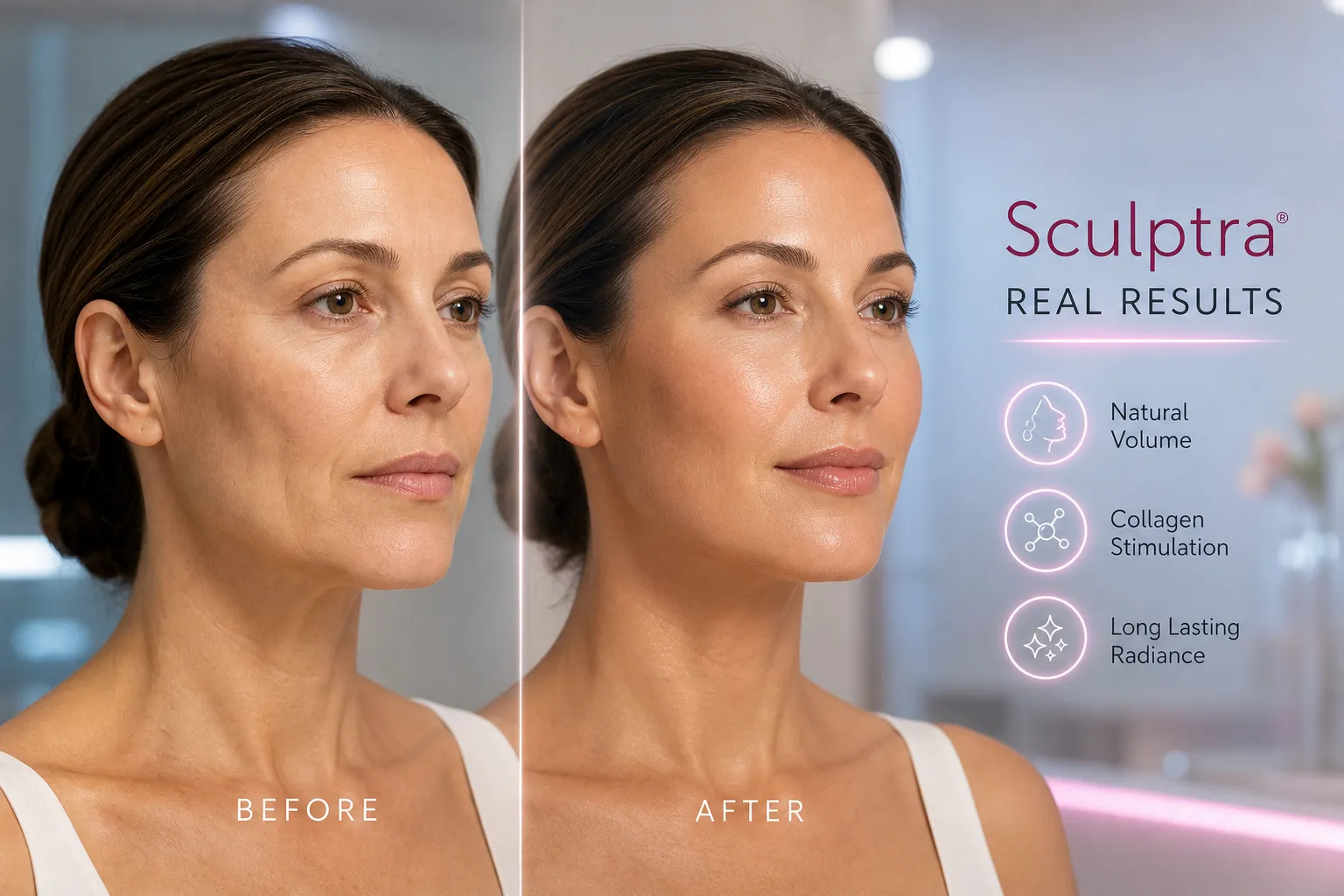
Sculptra before and after results look gradual and natural, not dramatic. The treatment works by stimulating your own collagen production over three to six months, so the transformation doesn't arrive overnight. Most people see the full picture only after their final session, once that collagen response has fully developed.
Online galleries make this hard to interpret. Photos vary widely in lighting, timing, and treatment scope, so what you're actually comparing isn't always clear. Some images are taken weeks after a single session; others are taken months after a complete course. Without that context, the photos tell an incomplete story.
TimeLyss Med Spa is a DNP-led practice on the Upper West Side that provides personalized care. What follows is an honest look at what the transformation actually involves: photo patterns, the collagen timeline, typical vial counts, downtime, longevity, and how to evaluate providers.
Key takeaways
- Results are gradual: Sculptra stimulates collagen over three to six months; meaningful changes are not visible immediately after treatment.
- Early fullness isn't the result: The initial fullness you see comes from injection fluid, not collagen. Genuine improvement typically begins around weeks four to six and peaks months later.
- Vial count varies by person: Most moderate full-face plans use two to four vials across two to three sessions; additional vials should be staged and reassessed.
- Minimal downtime: Most people return to normal activities the same day, with common side effects resolving within two to six days.
- Results last approximately two years: Clinical studies support about two years of noticeable benefit; maintenance is typically considered at 18 to 24 months.
- Provider selection matters: Injection technique and individual facial mapping are what separate a natural result from an overdone one.
What do real Sculptra before and after galleries actually show?
Most galleries mix treatments of different scopes, taken at different post-treatment intervals, under different lighting conditions. That inconsistency makes direct comparison genuinely difficult. Knowing what to look for helps you read what you're actually seeing.
Mid-face vs. full-face: how treatment scope shapes the visual result
Mid-face photos primarily show fuller cheeks, reduced hollowing beneath the cheekbones, and a smoother transition toward the nose and mouth. The nasolabial folds often look softer because surrounding cheek support improves, though they typically remain visible. The result is subtle rather than sharply contoured, and the face reads as more rested and slightly lifted rather than reshaped.
Full-face galleries tell a broader story. Improvements typically show across the temples, jawline, pre-jowl region, and areas around the mouth. The face looks less deflated overall, with improved skin firmness and texture alongside more balanced contour. This is a distributed change, not a single localized fill, and it moves gradually rather than all at once.
What to look for in authentic Sculptra results photos
Trustworthy comparison photos share consistent qualities: the same camera angle, a neutral expression, similar lighting, and a clear label showing how long after the final session the photo was taken. Photos labeled with their post-treatment timing are far more useful than those with no timing noted at all. Without that label, you don't know whether you're looking at swelling, early collagen activity, or a fully developed result.
Skin quality often improves before structural volume change becomes obvious in photos. This early shift in texture, radiance, and firmness is sometimes described as the "Sculptra glow", a real indicator of collagen activity showing up in skin quality rather than shape. If a gallery photo shows meaningful improvement in skin tone and surface quality alongside modest volume change, that's often a sign you're looking at an honest result rather than an edited one.
What does the collagen timeline actually look like, month by month?
The collagen timeline is the most practically useful piece of information for anyone starting Sculptra. Knowing what to expect at each stage prevents frustration during the weeks when no visible change is completely normal.
Month 1 to 2: swelling, waiting, and early subtle shifts
Immediately after treatment, there's noticeable fullness in the treated areas. This comes from the injected fluid, not collagen, and it fades within days to about two weeks. By the end of the first week, many patients feel they look nearly identical to how they did before the appointment, which is expected and not a sign that anything went wrong.
Around weeks four to six, subtle changes in skin firmness or texture may begin to appear. No visible change at this stage is completely normal; the collagen-building process is underway beneath the surface. Tracking how your skin feels, not just how it looks, can help you notice these early signs of activity. The structural improvement becomes visible later.
Month 3 to 6: when the transformation actually arrives
This is the stage where Sculptra's effect becomes genuinely visible. Noticeable volume and contour improvement typically develops over two to three months as collagen production increases. For a complete treatment course, full results are assessed three to six months after the final session, with many patients seeing the clearest improvement around four to six months.
This is also when meaningful comparison photos should be taken. Individual collagen response varies, so the timeline isn't identical for everyone, but the general arc is consistent: gradual improvement that continues building well past the last injection appointment.
How many vials do you actually need to see a visible difference?
Vial count is one of the most searched questions about Sculptra, and the honest answer is that there's no universal formula. The right number depends on your anatomy, the degree of volume loss, the areas being treated, and your individual collagen response.
| Total vial count | Typical outcome |
|---|---|
| 1 to 2 vials | Subtle refresh or skin quality improvement; usually insufficient for meaningful volume correction across multiple facial areas |
| 2 to 4 vials | Moderate full-face rejuvenation: gradual improvement in cheek and temple hollowing, skin firmness, and overall facial softening |
| 3 to 5 vials | More comprehensive correction for greater volume loss, typically staged over two to three visits |
| 4 to 6+ vials | Reserved for pronounced hollowing across multiple areas; should be staged and reassessed rather than added automatically |
Why session spacing matters as much as vial count
A common plan is two to three sessions spaced four to six weeks apart, using roughly two to four vials total for moderate full-face treatment. The provider should reassess your collagen response between sessions before deciding to add more.
Adding more vials without reassessment increases the risk of uneven texture, nodules, or an overly full appearance. The staged approach exists for a reason: it lets the collagen response guide the treatment rather than the other way around. Anatomy, baseline volume loss, skin quality, and individual collagen response all shape the final outcome, not vial count alone.
What does downtime and recovery honestly look like?
Sculptra is not a surgery-level commitment. Most people return to normal activities the same day, which makes it genuinely workable for a busy schedule. That said, there are real, temporary side effects worth knowing about so you're not caught off guard.
The first 48 hours: what's normal and what to watch for
Common side effects include swelling, redness, bruising, tenderness, and minor itching at the injection sites. The fullness you see immediately after treatment comes from the injected fluid, not collagen, so the initial appearance doesn't reflect your eventual result. Strenuous exercise, heat exposure, and activities that increase flushing should be avoided for the first 24 to 48 hours.
Injection-site reactions typically resolve within two to six days, though some can persist for up to one to two weeks. The FDA-approved patient labeling for Sculptra Aesthetic notes that some reactions may last as long as 17 days. These are common, expected, and not a sign that something went wrong; they're part of the body's normal response to the injection process.
Managing aftercare in the weeks that follow
As temporary fullness from the injection fluid fades, the treated areas may look less corrected before collagen production develops. This can feel unsettling if you're not expecting it, but it's part of the normal process, not a sign of a failed treatment.
Small, nonvisible bumps beneath the skin are common after Sculptra. Visible or persistent nodules, particularly those that are painful, enlarging, or inflamed, should be assessed by your provider promptly. Following your injector's specific aftercare instructions, including whether gentle massage of the treated area is recommended, is important for getting the best outcome from each session.
How long do Sculptra results last before you need a touch-up?
Sculptra results last approximately two years based on clinical study data. That's the most evidence-supported estimate, and it's a useful baseline for planning your investment and your maintenance schedule.
What clinical evidence actually says about longevity
In a key nasolabial-fold study, the FDA labeling reports effects lasting up to 25 months for some patients. Newer cheek studies reported sustained improvement through 96 weeks, which is roughly two years. These figures come from controlled study settings; real-world follow-ups suggest some patients see meaningful benefits closer to two to three years, though that's more variable.
After roughly two years, the effect fades gradually rather than stopping suddenly. Five-year follow-up data confirms that some residual improvement may persist beyond two years, but it does not mean every patient maintains consistent visible correction at year five. The product generally breaks down over about 18 months or longer, with product remnants detected in some skin biopsies up to 28 months after injection.
Planning maintenance around your collagen response
A practical expectation is 18 to 24 months of noticeable benefit, with some people seeing useful improvement closer to two to three years. Many practices consider a maintenance session at the 18-to-24-month mark, depending on the patient's collagen response, treatment area, lifestyle, and ongoing natural collagen loss from aging. These are population-level trends rather than a guarantee for any individual patient.
How to evaluate Sculptra photos and choose the right injector
The photos in a provider's gallery tell you as much about the injector as they do about Sculptra itself. Knowing how to read them is a practical skill that protects you from unrealistic expectations and poor provider choices.
Red flags in Sculptra before and after galleries
Inconsistent lighting, different expressions, or no post-treatment timing label all make a photo unreliable as a comparison. When a gallery shows dramatic results taken immediately after treatment, what you're seeing is almost always swelling, not Sculptra's actual effect. Overly symmetrical, sharply contoured outcomes that look like traditional filler results may indicate technique issues or photo editing rather than a natural collagen-based transformation.
Reliable Sculptra before and after photos are taken three to six months (commonly four to six months) after the final session, with consistent framing and no post-treatment swelling in the frame. If a provider's gallery doesn't meet that basic standard, treat the results with appropriate skepticism. A gallery full of same-day "afters" is a gallery that isn't showing you Sculptra's actual work.
Why anatomy-based, DNP-led care produces the most natural-looking results
The difference between a natural Sculptra result and an overdone one comes down to injection technique, dilution, and how well the provider maps treatment to your specific facial structure. Generic vial counts and standardized placement patterns tend to produce generic outcomes, and "generic" in aesthetics rarely looks right on an individual face.
TimeLyss Med Spa is led by Dr. Alyssa, a DNP and double board-certified nurse practitioner with over eight years of experience in injectables. The spa emphasizes medically grounded, personalized care. TimeLyss develops personalized treatment plans tailored to each client.
What to expect, honestly
The Sculptra before and after story is a slow one, told in collagen, unfolding over months rather than days. Reliable photos are taken three to six months after the final session, commonly four to six months, with consistent lighting and no post-treatment swelling in the frame. The realistic expectation for most people: two to three sessions, two to four vials for moderate correction, and roughly 18 to 24 months of noticeable benefit with possible maintenance after that.
The provider matters as much as the product. A consultation that maps treatment to your anatomy gives you the best chance at a result that looks like you, refreshed rather than altered. That's the bar worth holding any Sculptra plan to.
TimeLyss Med Spa is located on the Upper West Side and offers personalized aesthetic and wellness treatments. Reach out to our team to get started.
Frequently Asked Questions
Will I look overfilled right after Sculptra treatment?
You will often look fuller right after treatment, but that initial fullness is from the injection fluid, not collagen. That swelling typically fades within days to about two weeks, and genuine collagen-driven change appears later around weeks four to six and then more visibly over months three to six.
When is the right time to take comparison photos to see real results?
Comparison photos should be taken three to six months after the final session, commonly around four to six months. Photos taken immediately after treatment usually show swelling rather than Sculptra's effect, so consistent angle, neutral expression, similar lighting, and clear timing labels are essential for honest comparisons.
Can Sculptra improve skin texture and tone as well as volume?
Yes, Sculptra often improves skin quality before structural volume changes become obvious. Early improvements in texture, radiance, and firmness, the so-called "Sculptra glow", can be a real sign of collagen activity even when visible shape change is still developing.
How soon can I exercise or do strenuous activity after my Sculptra session?
You should avoid strenuous exercise and activities that increase flushing for the first 24 to 48 hours after treatment. Normal daily activities are usually resumed the same day, but these temporary precautions help reduce swelling and other injection-site reactions that commonly resolve within two to six days.
About the author

Dr. Alyssa Casciorizzo, DNP, APRN, FNP-BC, NP-C
As a Doctor of Nursing Practice (DNP) and double board-certified Family Nurse Practitioner (FNP-BC, NP-C) with over 9 years of experience, I focus on injectables like Botox, dermal fillers, and Sculptra, along with regenerative treatments such as PRP and advanced skincare solutions. I use cutting-edge techniques and a deep understanding of facial anatomy to create natural, transformative results.
Beyond my clinical expertise, I am a passionate Aesthetic Dermatology Nurse Practitioner dedicated to continuous education. This commitment to learning allows me to provide top-tier care and deliver treatments that leave patients with radiant, rejuvenated skin.