Botox vs Dysport: The Differences That Actually Matter
Botox vs Dysport: The Differences That Actually Matter
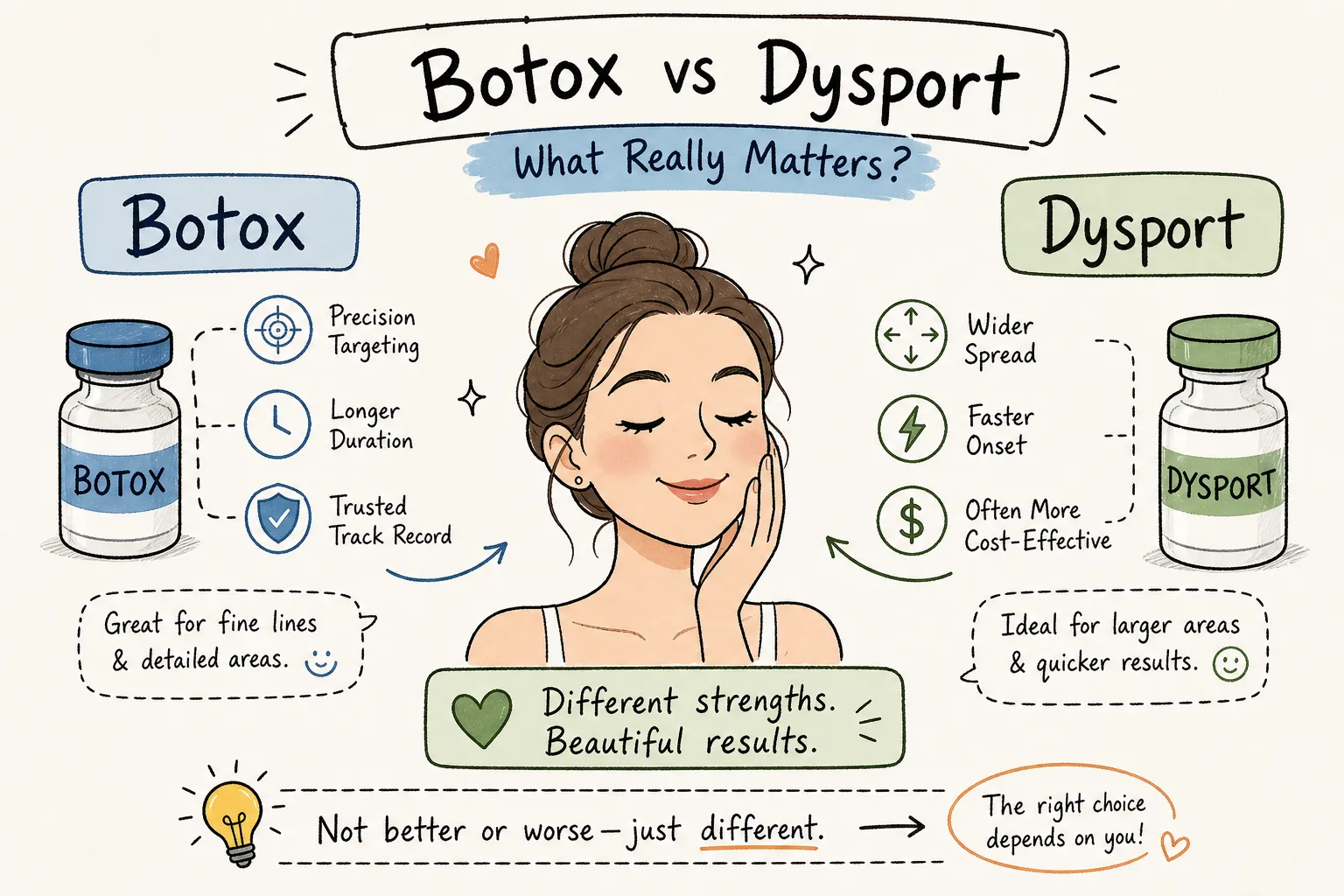
When comparing Botox vs Dysport, the first thing worth knowing is that both are botulinum toxin type A. Both relax the muscles that create dynamic wrinkles, and both last roughly three to four months. The practical differences between them are onset speed, how they behave in tissue, and how units are dosed. These differences are real, but they are narrower than most people expect, onset, dosing, and diffusion distinguish the two products, though clinical comparisons consistently show only modest, inconsistent differences when each is appropriately dosed.
The "which is better" debate is driven more by brand loyalty than by clinical outcomes. Anatomy, treatment area, and injector skill matter far more than the name on the vial. At TimeLyss Med Spa on New York City's Upper West Side, Dr. Alyssa, our DNP and double board-certified nurse practitioner, makes this call after evaluating each client's facial muscle activity and goals, not by defaulting to whichever product is currently trending.
Key takeaways
- Same core molecule: Both products use botulinum toxin type A and work by blocking acetylcholine release at the neuromuscular junction.
- Onset difference is modest: Dysport may show visible results in one to three days; Botox typically at three to five days. Both reach near-final results by 10–14 days.
- Units are not interchangeable: The commonly used clinical conversion is roughly 1 Botox unit to 2.5–3 Dysport units. Never compare them one-to-one.
- Diffusion depends on technique: Clinical evidence does not consistently show Dysport spreads farther; dose, volume, and injection method matter more.
- FDA approvals differ: Botox holds four FDA-approved cosmetic indications; Dysport holds one. Other uses are off-label.
- Cost often evens out: Dysport's lower per-unit price is offset by the higher number of units required for equivalent treatment.
Botox vs Dysport: what sets them apart at the formula level?
Botox uses onabotulinumtoxinA; Dysport uses abobotulinumtoxinA. The active molecule is identical in mechanism: it blocks acetylcholine release at the neuromuscular junction and temporarily prevents muscle contraction. What differs is the protein complex surrounding that core toxin. Botox carries an approximately 900 kDa complex, while Dysport's is approximately 500 kDa. Both products rapidly dissociate to the same 150 kDa functional neurotoxin after injection, which is why their core biological behavior is far more similar than the complex-size numbers suggest.
Because each product's unit system is brand-specific, comparing "20 units of Botox" to "20 units of Dysport" is a category error. The units reflect different biological assays, not the same measurement applied to two different products. Both are FDA-approved for cosmetic glabellar lines, the "11" lines between the brows. That shared starting point is worth remembering every time the debate gets heated.
Botox vs Dysport: onset and duration compared
Dysport's reputation for faster onset is partially earned. Clinical evidence shows Dysport can begin producing visible softening in one to three days, with some patients noticing changes within 24–48 hours, according to Cleveland Clinic Health Essentials. Botox typically shows visible improvement at three to five days. A randomized comparison found that onset for both products could be similar, around five days, which is a useful reminder that the difference is real but modest.
What "a day or two sooner" means in practice depends on your situation. If you're treating ahead of a specific event, the timing edge matters. For routine maintenance, it's largely irrelevant. Neither product delivers an overnight transformation, and you should wait the full two weeks before assessing results or reaching out to your injector with concerns.
How far does each product spread in tissue?
This is where the most persistent myth lives. The idea that Dysport consistently spreads farther than Botox is not well-supported by clinical data. A controlled study of 79 people measured electrical activity in an injected muscle and in nearby muscles; both Dysport and Botox produced similar target-muscle effects, with neighboring-muscle effects being smaller and shorter-lived for both products. Reviews consistently report no significant difference in diffusion between the two formulations.
What actually drives spread is injection volume, dilution, dose, technique, and local anatomy, not the brand on the vial. Dysport's potential for slightly broader coverage may be an advantage for the large, flat frontalis muscle across the forehead, where even distribution with fewer injection points is a reasonable clinical goal. For precision areas such as the lateral brow or close to the lower eyelid, tighter placement favors Botox. An experienced injector manages diffusion through technique, not by simply switching brands. The product is a tool; the hands using it determine the outcome.
Which facial areas favor Botox, and which favor Dysport?
No area is universally better served by one product over the other, but there are meaningful clinical tendencies. The table below summarizes what providers commonly prefer and what the evidence suggests for the four most requested treatment zones.
| Treatment area | Often favored | Key clinical note |
|---|---|---|
| Glabella ("11" lines) | Either; Botox may edge ahead for duration | Both are effective and FDA-approved here. Some trials found Botox produced longer improvement at standard conversion ratios; Dysport may begin working somewhat sooner. |
| Forehead | Dysport for broad, even coverage; Botox for precision | Dysport's wider field can suit the large frontalis. However, evidence is inconsistent and apparent advantages sometimes reflect higher relative Dysport dosing. Risk of brow heaviness if placement is off. |
| Crow's feet | Botox | Botox is FDA-approved for lateral canthal lines. Dysport use in this area is off-label in the United States and lacks equivalent regulatory standing. |
| Lateral brow | Botox for precision | A small, anatomically sensitive zone where excessive spread can alter brow position. Careful, individualized placement matters more than product choice here. |
The choice is rarely "which product is better overall." It is "which product suits this person's muscle activity, anatomy, and goals right now." Muscle strength, brow position, skin thickness, muscle depth, and prior treatment response all shape that decision. Some patients who respond poorly to one formulation may respond differently to another. Others prefer Botox's precision for smaller or more sensitive areas.
In this Botox vs Dysport comparison, the provider's reasoning process matters as much as the products themselves. At TimeLyss Med Spa, Dr. Alyssa, DNP, evaluates the muscle activity and facial structure of each client and matches the neurotoxin recommendation to what that person's anatomy actually requires, because the same treatment goal can call for different tools depending on the individual.
How do units and cost compare between the two?
The commonly used clinical starting conversion is roughly 1 Botox unit to 2.5–3 Dysport units, with some providers using up to 1:4 for stronger muscles. This means a typical glabellar treatment of 20 Botox units corresponds to roughly 50–60 Dysport units. The units reflect different measurement assays, not simply different concentrations of the same standard, so dosing is adjusted by treatment area, muscle size and strength, injection technique, and prior response.
In NYC med spas in 2026, Botox is typically priced around $13–$18 per unit, while Dysport runs approximately $6–$9 per unit, based on publicly listed pricing as of 2026. Because more Dysport units are required to achieve comparable treatment, the final cost for a session is often in a similar range. The most useful question to ask any provider is not "what do you charge per unit" but rather "what is the total cost for this treatment area, and what product are you recommending and why?" That framing cuts through unit confusion immediately and gives you a clearer picture of what you are actually comparing.
Choosing the right neurotoxin starts with the right consultation
The Botox vs Dysport question is often the wrong place to start. It frames a clinical decision as a consumer choice, which puts the focus on brand rather than on your anatomy. The more useful question is: what does my face actually need, and does my provider understand the difference between these products well enough to choose deliberately?
Before any consultation, it helps to arrive with clear questions. The four below are worth asking any injector, because they shift the conversation from brand preference to clinical reasoning, which is where it belongs:
- Do you offer both Botox and Dysport, and how do you decide between them for a specific patient?
- What treatment areas are you recommending, and why that product specifically for those areas?
- How many units are you planning to use, and what does the total cost look like?
- What results should I realistically expect at two weeks, and what would prompt a follow-up?
A provider who can answer these questions clearly, with reference to your anatomy and not just a standard protocol, is one worth trusting.
At TimeLyss Med Spa, our approach is not to push one neurotoxin over another. It is to evaluate the muscle activity and facial structure of each client and match the product to what that individual's anatomy actually needs. That is a different kind of consultation than walking in and asking for a brand by name. If you are in NYC and working through which option is right for you, that is exactly the kind of conversation worth having in person. Reach out to our team to schedule a consultation with Dr. Alyssa, DNP, and get a plan built around your individual structure, not around a product name.
Frequently Asked Questions
If one neurotoxin didn't work well for me before, can I try the other one at my next treatment?
Yes, some patients who respond poorly to one formulation may respond differently to the other. We evaluate your prior response, muscle activity, and anatomy to decide whether trying the alternate product makes sense for your next treatment.
When should I assess results and decide if I need a follow-up?
You should wait the full two weeks before assessing results and contacting your injector with concerns. We expect near-final results by 10–14 days and remind you that both products typically reach their settled appearance in that window.
About the author

Dr. Alyssa Casciorizzo, DNP, APRN, FNP-BC, NP-C
As a Doctor of Nursing Practice (DNP) and double board-certified Family Nurse Practitioner (FNP-BC, NP-C) with over 9 years of experience, I focus on injectables like Botox, dermal fillers, and Sculptra, along with regenerative treatments such as PRP and advanced skincare solutions. I use cutting-edge techniques and a deep understanding of facial anatomy to create natural, transformative results.
Beyond my clinical expertise, I am a passionate Aesthetic Dermatology Nurse Practitioner dedicated to continuous education. This commitment to learning allows me to provide top-tier care and deliver treatments that leave patients with radiant, rejuvenated skin.