
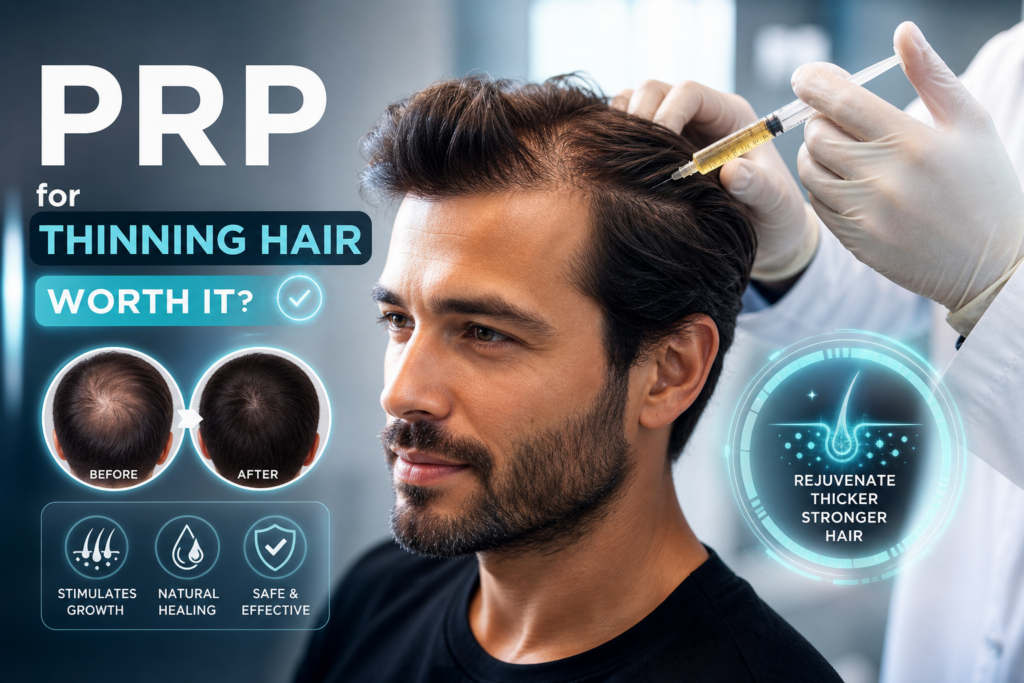
If you’re asking whether PRP injections for thinning hair actually work, you’re not alone, and you deserve a straight answer. Hair thinning affects a significant portion of the population at some point in their lives, and most people eventually land on the same question: is there anything that actually works besides drugs? PRP therapy for thinning hair has gained real traction as a non-surgical option, showing up in dermatology offices, hair restoration clinics, and med spas across the country. The conversation around it ranges from genuine enthusiasm to flat-out hype, depending on who you ask.
At TimeLyss Med Spa on the Upper West Side, platelet-rich plasma therapy for hair restoration is one of the more nuanced conversations we have with clients. The treatment works. But it does not work for everyone, it does not work the same way for everyone, and it absolutely does not work the way some clinics market it. Real expectations matter here because this is real money and real time invested in a decision about your appearance.
By the end of this article, you will know exactly what PRP is, what the science actually supports, what a realistic treatment plan looks like, what it costs, and what questions to ask before you commit to anything.
What PRP therapy is and how it works on your scalp
The process starts with a blood draw from your arm. Volumes vary by protocol and preparation method, so the exact amount depends on the system your provider uses. That blood goes into a centrifuge, which spins it down and separates its components: red blood cells, white blood cells, platelet-poor plasma, and platelet-rich plasma. A double-centrifuge protocol concentrates the platelets to roughly 3 – 5 times your baseline blood concentration. That concentrated fraction is what gets injected directly into your scalp.
PRP is not a drug. It is not synthetic. It is a concentrated portion of your own blood, which is part of why the safety profile is generally favorable. Because it comes from your own body, allergic reactions to the PRP itself are rare. It is worth noting, however, that reactions to other components used during the procedure, such as topical anesthetics or antiseptics, can occur, and a thorough intake assessment will screen for those. The whole point of PRP is to deliver a high concentration of platelets to the treatment area so they can release growth factors exactly where you need them.
Those growth factors include PDGF, VEGF, EGF, IGF-1, and FGF. They signal follicles that are resting or miniaturizing to shift back toward active growth. In androgenetic alopecia, the pattern most people think of as male or female pattern hair loss, the follicles do not die. They shrink over time due to DHT sensitivity. That distinction matters because it means there are still follicles to stimulate. PRP cannot resurrect a completely dead follicle, but it can wake up one that has been dormant.
A typical session involves topical numbing applied to the scalp first, then the blood draw and PRP preparation while you wait, then injections spaced across the thinning area. Procedure time varies by practice and technique, but most sessions are completed well under two hours. Some providers add microneedling alongside the injections; this is a variation in technique, not a standard requirement, and research on whether it meaningfully improves outcomes compared to injections alone is still limited. For a clear, clinic-friendly walkthrough of the patient experience, see our What to Expect During a PRP Treatment | Step-by-Step Guide.
Do PRP injections for thinning hair work, what the evidence says
The consistent finding across randomized controlled trials and systematic reviews is that PRP injections for thinning hair produce meaningful improvements in hair density and terminal hair count in patients with androgenetic alopecia, in both men and women. The signal for hair density specifically is the most reliable across studies. Other outcomes, like hair mass index or patient-rated styling satisfaction, are less consistently replicated. Several randomized controlled trials and systematic reviews summarize these effects and the overall quality of the evidence.
The honest characterization of the benefit is modest to moderate, not transformational. If you go in expecting a full head of hair after three sessions, you will be disappointed. If you go in expecting measurable improvement in density and a reduction in shedding over several months, you are operating in the realistic zone where the evidence actually lives.
The research has real limitations worth acknowledging. Most trials are small, and follow-up periods are often short, sometimes just three to six months, as documented across multiple systematic reviews of PRP for hair loss. There is no standardized PRP preparation protocol across studies, which makes direct comparisons difficult; this heterogeneity is described in the literature and complicates meta-analysis of outcomes (see discussion of protocol variability). Many systematic reviews explicitly frame PRP as a coadjuvant treatment, meaning it tends to perform better alongside established therapies like minoxidil or finasteride than as a standalone replacement. That is not a reason to dismiss it. It is a reason to go in with calibrated expectations and a clear understanding of where it fits in a broader hair health strategy.
Who tends to respond best: early-stage thinning with miniaturized but living follicles, confirmed through clinical assessment. Alopecia areata and telogen effluvium respond differently than androgenetic alopecia; the evidence base for those conditions is considerably weaker, and any provider worth seeing will evaluate each case individually before recommending a course of treatment.
What a realistic treatment plan looks like
The standard initial protocol in clinical practice is a minimum of three sessions spaced approximately four to six weeks apart. Some providers run monthly sessions for three consecutive months; others use slightly longer intervals based on their assessment of the individual patient. The specific spacing matters less than this core principle: no single session produces lasting change. The cumulative effect from repeated treatments is what drives results.
After the initial course, most patients need booster sessions every six to twelve months to sustain what they gained. Without maintenance, both the research and real clinical experience suggest that improvements can fade within several months. This is not a one-time fix. Anyone who tells you otherwise is either misinformed or trying to close a sale.
Most patients begin noticing changes around the three-month mark, often starting with a reduction in active shedding before any visible density improvement. Full results from the initial course are typically assessed at six months. Patience is not optional here. The timeline is measured in months, and the change is gradual enough that before-and-after photos are genuinely useful for tracking progress because the improvement can be hard to perceive day to day.
Costs of PRP injections for thinning hair: what to expect
In the United States, per-session pricing runs from roughly $600 at lower-overhead suburban practices to $2,000 at established dermatology or premium med spa practices in major metros. A standard initial three-session course typically runs $1,500, $6,000 when bundled, though some clinics price sessions individually at the higher end of the range. What drives the price: overhead, provider credentials, PRP preparation method, and whether diagnostics or aftercare are included.
In New York City specifically, the realistic per-session range at established practices is $800 – $1,500, with many experienced providers landing around $1,000 per session. A three-session initial course in NYC commonly runs $2,700 – $4,500 depending on the clinic and whether package pricing is offered. If you want clinic-specific pricing and location information, see our page on PRP Injections for Hair and Skin Rejuvenation in New York.
Insurance does not cover this. It is classified as cosmetic across virtually all carriers. Budget for the full picture before you start: an initial course plus two maintenance sessions over two years can realistically exceed $4,000 – $6,000 in a high-cost market. That is the honest number. Go in knowing it.
Side effects, risks, and who should not get PRP
The most common side effects are scalp soreness, redness, mild swelling, and tenderness at the injection sites immediately after the session. These typically resolve within 24 – 72 hours. Temporary shedding can occasionally occur in the weeks following treatment; this is self-limiting and generally resolves on its own. Bruising and itching at injection sites are also reported but uncommon.
Rare but documented complications include infection at the injection site, allergic reactions to anesthetic agents used during prep, and subcutaneous nodules or scarring. Serious adverse events are uncommon in clinical trials, but proper sterile technique and skilled administration significantly reduce this risk. This is one of the clearest reasons why provider credentials and clinical environment matter more than finding the lowest price.
Contraindications include active scalp infection, platelet disorders, blood clotting conditions, and certain autoimmune diseases in active or unstable phases. For patients with conditions like lupus or rheumatoid arthritis, PRP is typically a relative contraindication requiring case-by-case clinical assessment rather than a blanket exclusion or an automatic green light. Pregnancy and breastfeeding are excluded due to insufficient safety data. Patients on blood thinners or with uncontrolled diabetes should discuss suitability with their provider before booking anything.
How PRP compares to other options, and how to choose a provider
FDA-approved first-line treatments such as minoxidil and finasteride have a longer evidence base than PRP. They are the established first-line treatments for androgenetic alopecia, and PRP injections for thinning hair are not a replacement for them. The clinical literature consistently positions platelet-rich plasma therapy as complementary.
Published head-to-head trials show PRP is roughly comparable to minoxidil for hair density outcomes in some studies, and slightly better in others, but the difference is not consistently statistically significant. For finasteride, direct head-to-head trial data comparing PRP alone versus finasteride alone is limited; the stronger evidence supports PRP as an add-on to finasteride, not a substitute for it. Several studies suggest better outcomes when PRP is used alongside standard treatments rather than instead of them.
For patients who cannot tolerate medication side effects or want a non-pharmacological approach, PRP offers a biologically grounded option with a reasonable evidence base, specifically, the ability to stimulate follicular activity using your own growth factors rather than a pharmaceutical agent. That is a legitimate reason to pursue it, as long as the expectations are calibrated correctly.
Before you book with any provider, ask these specific questions:
- What PRP preparation method do you use, and what platelet concentration does it achieve?
- How many sessions do you recommend based on my specific pattern and stage of loss?
- What realistic outcomes can I expect at my stage of thinning?
- What credentials does the person performing the injections hold?
- What does your maintenance protocol look like after the initial course?
The difference between a practitioner-led clinic and a technician-operated one is meaningful when it comes to injectable treatments. At TimeLyss Med Spa, every PRP hair restoration consultation and treatment is performed by Alyssa, a Doctor of Nursing Practice and board-certified family nurse practitioner with over eight years of injectable experience. Clients receive a proper clinical evaluation, a personalized treatment plan built around their specific anatomy and loss pattern, and consistent care from the same provider every session. The goal is always to tell you what is realistic, not just what you want to hear.
The bottom line on PRP injections for thinning hair
PRP injections for thinning hair represent a legitimate, science-supported option for the right candidate. The evidence supports real but modest improvement in hair density, particularly for early-stage androgenetic alopecia in patients who still have viable follicles to stimulate. It is not a miracle, and it is not cheap. It works best as part of a broader hair health strategy alongside proven treatments, not as a standalone cure.
The key action steps are straightforward. Get a proper clinical evaluation before committing to anything. Understand your specific hair loss type and stage, because that determines whether you are a good candidate in the first place. Ask direct questions about protocol, expected outcomes, and the full cost over time including maintenance. Do not let a low per-session price be the deciding factor when provider skill is what actually drives results.
If you are in New York City and want a straight assessment rather than a sales pitch, book a consultation at TimeLyss Med Spa on the Upper West Side. Alyssa will evaluate your specific situation and tell you exactly what is realistic, what is not, and what a plan that actually makes sense for you looks like.